Our latest exhibition, Knowing Your Knowsley: A Celebration of Local and Community History, has officially begun.
Highlighted are historical items and documents from the townships that make up Knowsley. Each of our cabinet spaces has been dedicated to townships such as Kirkby, Prescot, Tarbock, Halewood, Whiston, Cronton, Tarbock, and Stockbridge Village.
The month of May 2026 is highlighted as Local and Community History Month by the National Year of Reading. Here at Knowsley Archives Service, this is being celebrated with a themed exhibition to memorialise Knowsley’s heritage and the stories of the communities that make up the borough.
An exclusive cabinet will be showcased at Huyton Library in two weeks time, where you will be able to find historical photographs, books and artefacts which speak to the rich history of Huyton-with-Roby. We are proud to be presenting some never-before exhibited documents and pieces from the Archive Collections in the cabinet, which will be located in the Local History section of the Library.
A Sneak Peak…
The exhibition space here at Knowsley Archives, will also be featuring new and exciting documents and artefacts that have never been displayed before, which tell the story of Knowsley and its townships from Domesday to more recent times.
The exhibition opened at Kirkby Library on Monday 30th March and will be running until the 29th May 2026. The Exhibition Cabinet at Huyton Library will be available for viewing from the 9th April 2026.
Be sure to keep an eye on our social media for details of our exciting events happening in May, aimed at telling the fascinating stories of Knowsley and evoking the memories of the community.
We started the year with our annual stock take, where we carry out essential housekeeping tasks such as reorganising the shelves to maximise space and checking the condition of items and repackaging them so that they are protected for permanent preservation.
This year, our attention was focused on last year’s big acquisition, the British Insulated Callender’s Cables collection – transferred to us from National Museums Liverpool. The items in the collection were carefully checked and arranged ready for the next stage in the process.
We are now looking ahead to working with our Library Service colleagues to celebrate the National Year of Reading. Not only is May ‘Share a Story’ month, but it is also Local and Community History month. We’ll be on hand to share stories from the Archive through a series of events, talks, displays and exhibitions.
Items from the BICC Collection
We start at the beginning of April with an exhibition featuring Knowsley’s townships in the Archive’s exhibition space in Kirkby Library. Original records, maps and photographs will highlight the ancient townships of Cronton, Halewood, Kirkby, Knowsley, Prescot, Tarbock and Whiston alongside Stockbridge Village, a 20th century development built on ancient lands. If you’re interested in Huyton and Roby, Huyton Library will be the venue for a display of documents, photographs, maps and an unusual object with an interesting history…
A view of a previous exhibition, ‘Famous and Unknown’, featuring the story of Stefan Skura
Because we will be showcasing original records, we use archive and museum standard display cases to protect the exhibition pieces. This is why we are siting the exhibitions at Kirkby and Huyton – but don’t worry: we will be offering a range of events and activities in your local library throughout May. Keep an eye on our social media for details of author talks, reminiscence sessions, local history talks, film shows and other events aimed at telling the story of Knowsley and sharing your stories and memories!
Our latest exhibition, Behind Closed Doors, is a yearly pop-up exhibition which highlights the work undertaken during the annual stock take.
Every January, for two weeks, the ARK closes the doors to the search room to have its annual stock take. During this time, customer enquiries can still be answered remotely via email and phone.
The purpose of the exhibition is to show the detail of work that is undertaken to preserve and correctly store items within our collection. The items featured, show what is used to help preserve the collection, such as specially produced archival storage materials like folders and acid free polyester pockets for more fragile documents and photographs.
The importance of the stock take is to highlight items that need to be repackaged, and to have a general documented knowledge of the condition of the many items within the collection. For the duration of the two weeks, customers are given an update via social media platforms at the end of each week, on how the stock take is going, highlights and what has been rediscovered amongst the collection.
Previous rediscoveries during the stock take have been:
• A tiny conveyance for ‘Messuages and land in Whiston’, dating from 1652, with part of the seal still attached
• Huyton-with-Roby Urban District Council volume of meticulously recorded road and footpath measurements, compiled by surveyor William Wrennall in 1879.
• During a repackage of the Kirkby Liberal Historical Society collection, a fascinating story from 1971 about a live lizard found in timbers at a local timber yard that was sent to Liverpool Museum and identified to be a member of the Agamidae Family. The lizard survived its ordeal and thrived under the care of the Zoological Department of Liverpool Museums (now National Museums Liverpool)
• Whiston School Log book that is lockable, complete with key
The stock take underway, removing damaging staples and replacing them with brass paper clips and repackaging items in proper archival folders!
The BICC Collection
This year, the annual stock take is dedicated to the recently acquired British Insulated Callender’s Cables (BICC) collection featuring:
• Business minutes and records,
• Job cards
• Staff magazines documenting social activities
• Photographs and film reels
The main office building of the British Insulated Wire Co. Ltd, Prescot.
This vast collection provides a remarkable insight into the history of the BICC and the records outline the timeline of the company’s significant impact both locally and internationally. The collection had previously been held at the National Museums Liverpool, following the closure of the main factory in Knowsley. However, in spring of 2025, the extensive collection was successfully acquired by Knowsley Archives and has returned to its origins here in Knowsley.
The exhibition will be running from Friday 9th January to Friday 30th January 2026, so don’t miss out, pop in to visit us and the exhibition today! It is located at Knowsley Archives Service in The Kirkby Centre.
For more information, please don’t hesitate to contact us on 0151 443 4291 or via our email at: infoheritage@knowsley.gov.uk
Our latest exhibition, ‘Christmas in the Archives: The Sentiment of a Christmas Message’, features cards, letters and postcards from multiple collections located within Knowsley Archives Service.
These items highlight Christmas messages sent from around the world, to and from residents right here in Knowsley, spanning from the 1910s to the 1990s. A few were from family in active duty sending seasons greeting to their loved ones, others from friends to friends wishing their family joy and happiness for the New Year and a charming Christmas greeting from Huyton Parish Church.
Many of the cards featured, hold a traditional Christmas design either, made by hand or manufactured. However, a good selection of them features unique designs such as a garden in full summer bloom and a view of Prescot in 1743.
What is on display?
Featured within the exhibition, are a few traditional Christmas Cards that we would expect to see today when purchasing a card for a loved one. However, many of our cards and letters do not feature a traditional Christmas design but have more focus on sending well wishes and feature such scenes like a garden in full summer bloom and prints of buildings and churches.
This marvellous card captures the essence of Christmas with rich colours of red and green, blooming poinsettias, complete with both an illustration of a red ribbon and a real ribbon in a bow on the front. On the back of the card are signatures from twelve students as this card was for their teacher, Miss Hodge.
Collections featured within the exhibition are:
Malayan Teacher Training College Collection
World War Two Letters Collection
Sally Whittaker’s Collection
Prescot Records from Tickle, Hall & Cross Collection
Councillor Peter Kelly Collection
Huyton Labour Party – St Bartholomew’s Ward Collection
There are many more cards and letters to view at the exhibition, which is running until the 6th January 2026, so don’t miss out, pop in to visit us and the exhibition today! It is located at Knowsley Archives Service in The Kirkby Centre.
For more information, please don’t hesitate to contact us on 0151 443 4291 or via our email at: infoheritage@knowsley.gov.uk
Our latest exhibition, ‘Playtime Isn’t Over: Toys and Games Throughout The Decades’ features historical artefacts, from our collection at Knowsley Archives, that are typically shown as part of School talks and visits.
Previously, these items were not normally seen by or displayed to the general public. The exhibition is running from Monday 14th July 2025 until Monday 15th September 2025. Though it has now been extended due to popular demand until the 31st October2025. Highlighted in the exhibition are popular toys and games, spanning from the beginning of the 20th Century in 1900 to the end in 2000. It has also ran in conjunction with the travelling Retro Games Exhibition called, ‘Gaming Together’, held at Kirkby Library during the Summer Holidays in 2025.
A peak inside the glass cabinet
A Brief History Toys and Games
For thousands of years, games have been a fundamental part of any culture from around the world and have always been one of the most longstanding forms of social interaction between people. As most board, dice or even card games can include elements of uncertainty of the outcome, an agreement of rules, competitiveness, and chance, this can then create cultural and social bonds between generations and communities. These pastimes can continue to live and evolve for thousands of years, just from being taught to future generations.
From an archaeological perspective, the origins of board games can be linked to the ancient Near East, in modern day geography this is located within the Middle East. One of the earliest forms of board games can be dated as far back as 2620 BCE, called Senet. This was popular amongst the Ancient Egyptians during the First Dynasty and was even discovered years later within the tomb of Tutankhamun. However, of the oldest and playable board game is, The Royal Game of Ur, which is a two-player race and war game that is similar to how Backgammon is played. This game can be dated back to 2400 BC.
A war game with a race to the end! – The Royal Game of Ur
As this game is no longer played in modern times and since there have been no rules or how to guides passed down through centuries. It has been up to renowned historians such as H. J. R. Murray and Robert Charles Bell to understand how to play this unusually shaped board and what path the counters will take during each players turn.
However, the most commonly played rules for the Royal Game of Ur were reconstructed by Professor Irving Finkle, who also designed a simplified version of how to play the game. This version can be played online against another player or a robot. Both historians have left their mark on the history of games, with Bell giving origins into many board games and dividing them into four main categories such as, Mancala games, War games, Positional games and Race games. The legacy left from Murray was a published book that served as an extensive record into the game of Chess from its origins to its development across Europe, titled A History of Chess.
Back into the 19th Century
Moving into the 19 Century, toys and games began to serve as a more educational purpose to children and to assist then in their gender roles at that time. They also served the purpose of helping children think about what they would want to be when they grow older and began the journey into adult working life. Such toys for young girls would involve teaching them domestic skills such as tea sets or even a toy sewing machines. Yet, for young boys, their toys would be items such like trucks, cars or even Military themed with toy soldiers.
During the span of the 20th century, toys and games continued to adapt at a rapid pace. From the beginning decades of the century, with the focus still being on primarily wooden based toys and parlour games, it was due to the events of the Two World Wars, that change began. The need for different types of material to be used for the War efforts, families across the UK adapted to the change and created toys, games and even soft teddies with everyday household items and basic crafting and sewing.
After the end of the War, toys and games began their journey towards mass production with such material as plastic for both gender-based toys, such as dolls for girls and soldiers for boys.
From the mid to late 20th Century, aspiring inventors, designers and manufacturers began to formulate the market with the latest and greatest ‘must-haves’, that would be at the top of almost any children’s Christmas list. However, with this also began the slow introduction into what was mass production, over consumerism and the need to own the latest toy or game.
Now in the 21st Century, toys and games are ever changing and adapting. Whilst there are still toys and games that try to hold an educational aspect to them. Many are still attempting to still teach them about their roles in adult and domestic life, they are no longer bound to one gender but are aimed at both girls and boys. However, most modern toys and games now hold either a fantasy or mythical element to them, as the need to help a child create an imaginative world exceeds the need to teach them about everyday life and what to expect in adulthood.
However, the reoccurring issue with some of the modern toys and games, is that they are not as durable as their predecessors which had been made out of solid materials such as wood. As some can be made out of easily breakable material, it poses a risk that they are not ‘built to last’. Sadly, a large majority of the toys and games that end up being purchased as they are part of a current trend, that they will simply end up in landfill, unable to be passed down through generations.
As we progress further into the 21st Century, many adults of all ages from all decades are finding fond memories through what toy or game that was popular when they were a child. Even going as far as purchasing ‘vintage’ or modern remakes for their own children or grandchildren to fully appreciate or enjoy what they did at that age.
Whether these fond toys and game will continue to withstand time and environmental factors, it is apparent that even their memory and how they made a child feel, will keep them alive for generations to come.
What is featured within the exhibition?
The items featured in the Glass Cabinet span across the 20th Century and visually show how much toys and games have developed through the decades
The Exhibition Space is spilt into three spaces, Space A, Space B and Space C. Whilst Space A consists of the larger and more eye-catching glass cabinet, Space B and Space C are made up of eight sectioned cabinets. The glass cabinets hold a mixture of items from different decades, showing a stark contrast between traditional wooden and rope toys such as Hoopla and the on-the-go convenience of the Rubik’s Cube. This post will highlight a specific toy or game from each exhibition space, providing both further information into the history of the item and a close up image.
Space A: Glass Cabinet – Hoopla or Quoits
Material: Wood and Rope Date: 19th & 20th Century
The difference between the two games is that Hoopla can normally be played at fairgrounds with the chance to win a prize. While Quoits is usually a played at home for fun and minor competition amongst friends and family. There is a third version of the game called Deck Quoits, normally played on a ship. However, this version is more informal, and the centre point can either be a raised wooden peg or a marked circle.
Passengers playing Deck Quoits on board the liner Franconia at Liverpool, June 1923.
Space B: 1900s to 1930s – Diabolo
Material: Wood, Metal and String Date: 19 and early 20 Century
Historically known as ‘The Devil on two Sticks’, until the early 20th Century, Diabolo was originally derived from the Chinese Yo-Yo and saw a peak in popularity during the 19th Century. After a more modern version of the game was pioneered in the 20th Century, only then was the name changed to what we now know as Diabolo. Popularity for the game decreased rapidly after 1910 due to cartoons in newspapers mocking public figures of the time, playing with the toy. The most basic and fundamental trick was simply called Toss, and this involved tossing the Diabolo in the air and the user doing a turn in place or even a skip over the string whilst the diabolo is still in the air. Those who were skilled in the game could spin multiple Diablos’ on a single string.
Australian Swimmer, Annette Kellerman, playing with a Diabolo, 1907
Space B: 1940s – Pick Up Sticks
Material: Wood and Metal Date: 20th Century
This game of dexterity and daintiness goes by many different names, Pick-A-Stick, Fiddlesticks and Jack Straws, but has been an enjoyable past time for centuries.
Whilst more modern versions of the sticks are coloured plastic or a more varnished wood with colouring markings on the end, they used to be made from all kinds of different materials. Previously during Victorian times, when upper-class families would play Pick Up Sticks, these sticks would have been made from ivory or bone. In earlier centuries, bamboo, straw, or even yarrow would have been used for the sticks.
To play, at least two players are needed, and the rules are that the youngest player goes first before following a clockwise direction to the next player. Setting up the game requires a more elaborate arrangement, with one player holding the sticks in one hand, making sure they are all standing vertical and a couple of centimetres up in the air.
The player will then release them, letting the sticks fall and once they have all landed, then the game can begin. Each player has to move a stick without touching or moving any of the other sticks, if they do, then their turn ends, and they must let go of the stick they were trying to reach.
Space B: 1950s – Whip and Top
Material: Wood and String Date: 20th Century
This toy has gone by many names throughout the mid-20th Century. Many know it as the Whip and Top, or Whipping Top, though it was also known as a Whip and Peerie. It also gained the name Window Breakers, as if you were too enthusiastic when whipping them, they would shoot into different directions and cause accidents.
Typically, it was played in the street with friends, rather than in the confined space of the living room. Although accidents could happen, if you were to miss the top and accidently whip your leg, it would be rather painful. To get the full benefit out of playing with the Whip and Top, securing hours of fun, it required plenty of practice and patience.
It was common amongst children to draw different designs and patterns on the top with chalk, so that when it was spinning, their designs would come to life
Space B: 1960s – Marbles
Material: Glass Date: 16th Century and onwards
It is believed that marbles arrived in Britain during the medieval era, although there have been archaeological discoveries that link stone and clay marbles as early as 2500 BCE. They were firstly popular in South Asia before becoming popular in the 16th Century in Germany. The term Marbles is believed to be originated from the area of Nuremberg, with the town council limited the playing with marbles to a small field outside the town.
One of the most popular marble games in the UK is called, Ring Tar, which dates back to the 18th Century, and it is similar to how billiards is played. For this game, at least two players are needed, an equal number of marbles per person and the Tar is normally a marble that is larger than the rest. Making a circle with chalk, each player will then place their marbles within the circle. Taking turns, each player uses the Tar to knock their opponents marbles out of the marked ring. The one left with the most marbles wins.
There are over thirty different games to be played with marbles, some just using the marbles and others having additional components such as marble painting or marble maze.
Since 1932, there has been the British and World Marbles Championship held in Tinsley Green, West Sussex.
Space C: 1970s – Kaleidoscope
Material: Card and Plastic Date: 19th Century and onwards
The Kaleidoscope was invented by a Scottish inventor, David Brewster in early 18th Century, and he derived the name from three Greek Words. The words, Kalos, which can mean beautiful or beauty, Eidos which means form or shape and Skopeō which can mean to look at or to observe.
The Kaleidoscope gained popularity in America in the late 19th Century, after it was revitalised by a man named Charles Bush who then went on to mass produce the toy.
The device consists of mirrors or mirrored strips within the tube, at the top there is a disk of coloured plastic or glass. The viewer can then look through the small hole at the bottom, holding the Kaleidoscope towards the light, rotating the tube around and creating striking visuals with the loose plastic or glass against the mirrors.
Popularity for the toy peaked in the Victorian age amongst upper class families as it was seen to be an amusing form of family entertainment used in the most formal room of the house, the parlour.
A peek Inside our Kaleidoscopes
Space C: 1980s – Etch-A-Sketch
Material: Mixed Plastic and Aluminium powder Date: 1960s and onwards
Although the Etch-A-Sketch was invented in the 1960s by a French inventor and technician, André Cassagnes, it was popular in the 1960s and continued its success into the 1970s and 1980s. It offered a unique and captivating way to create doodles or more detailed drawings. The mechanics of the toy are rather complex.
The two dials operate different directions, one for left to right and the other for up and down. The inside of the screen is coated in a thin layer of aluminium powder. When these dials are controlled, a stylus scrapes away the aluminium powder and creates a dark line that is used for the drawing process.
Don’t Miss The Boat! – A fun puzzle to complete when placed on top of the Etch-A -Sketch
Space C: 1990s – Beanie Babies
Material: Synthetic plush and polyester fibre Date: 1990s
Beanie Babies were first launched in 1993 at a Toy Fair in New York, by Harold Ty Warner who also founded Ty corporation. At first due to their limited availability, Beanie Babies were initially sold in small or independent businesses and specialised gift shops. The reason for the sudden influx in 1995, was Ty began to be retiring certain animals. However, this has been deemed to be an example of artificial scarcity, therefore creating more demand.
This approach was also combined with Ty limiting the distribution of the teddies to shops, with them selling 36 of any one teddy to these small businesses at a time. This is how the Beanie Baby frenzy begun.
As the 1990s came to an end and the 2000s began, Beanie Babies begun to rapidly decline in popularity and only in 2008 they reappeared and were now called Beanie Babies 2.0.
In Las Vegas in 1999, a recently divorced couple were ordered by a judge to divide up their Beanie Baby collection, one by one in the court room.
Space C: 2000s – Scooby Strings
Material: Plastic String Date: 2000s
In the mid-2000s, a new trend began to form within primary and secondary schools across the Britain, Scooby Strings. These strings went by many different names and spellings such as, Scoubis, Scoobies, Scoubidou, Skoobies and Scooby Doos.
The trend had originally formed in France before coming to the UK, but it is believed to have originated from Chinese knotting and the technique is commonly used for making ropework.
The strings could come in many different colours and variations such as glitter and neon, and through the process of weaving and knotting could become keychains to attached onto bags and keys. Not only were they creative pastime, but it was the peak of friendship if you made each other friendship bracelets with the Scooby Strings, featuring each other’s favourite colours.
There are still many more different toys and games to view at the exhibition, which is now running until 31st October 2025, so don’t miss out and pop in to visit us and the exhibition today!
For more information, please don’t hesitate to contact us on 0151 443 4291 or via our email at: infoheritage@knowsley.gov.uk
The exhibition is located at: Knowsley Archives Service at The ARK (Archive Resource for Knowsley)The Kirkby Centre – First Floor, Norwich Way, Kirkby, L32 8XY
Now that the VE Day 80th Anniversary celebrations have come to an end, so has our exhibition, Experiments in Propaganda: History and Tragedy of the Royal Ordnance Factory. The exhibition ran from the 14th April 2025 to the 26th May 2025, and was extended due to popular demand until the 6th June 2025.
Featured within the exhibition was the timeline of the beginning of the Royal Ordnance Factory to its transformation into what is now known as the Industrial Estate. Also included, was how the Factory was shaken by two substantial explosions, that took the lives of many workers and injured many more, and the accounts of the heroic workers.
If you missed the exhibition, here is a link to the exhibition catalogue that highlights the items that were featured such as reports, photographs, maps, records and artefacts.
Keep an eye for future changes on our website that will have a page dedicated to previous exhibitions catalogues being made available digitally for you to view in the comfort of your own home.
As we progress further into 2025, we have only just begun on a year of exciting exhibitions and events featuring items from our collection. We will keep you updated on further developments for any other exhibitions hosted and curated by the team at Knowsley Archives.
Alternatively, you can also keep up to date with our upcoming exhibitions and events via our social media channels;
As we approach the landmark 80th anniversary of the end of WWII, we are taking a closer look at the events that occurred at the Royal Ordnance Factory and the stories of the people who worked there. This blog post is in conjunction with the latest exhibition held at Knowsley Archives, titled, ‘Experiments in Propaganda: History & Tragedy of the Royal Ordnance Factory in Kirkby’ and features items from the Royal Ordnance Factory collection.
The Timeline of the ROF
The Royal Ordnance Factory was based on the outskirts of Liverpool in the rural area of Kirkby and was responsible for producing munitions during the Second World War. The factory was in production from September 1940 until its closure in March 1946.
The history of the ROF Kirkby begins in 1939, as Liverpool Corporation began negotiations with the Earl of Sefton to purchase land within Kirkby for industrial development, however due to the outbreak of the Second World War, these plans were abandoned. In the same year, after already approving of four filling factories, the Government decided to have an addition of two more and the sites chosen were located at Risley and Kirkby. These factories would be responsible for placing explosives and propellants into casings. In the early 1930s, there had previously been only three of these factories within England, and due to their location around the London area, there was a danger of them being bombed. Due to this, a committee was set up to assess possible locations that were away from London and the surrounding area.
Early developments for the ROF Kirkby were done at the Royal Arsenal Woolwich in Southeast London and by 1939, a 740-acre site was purchased from the Earl of Sefton for the cost of £310,000, though this was formally completed in 1943. In today’s money, this would have been priced at £17,259,967.33. However, before the contractors could move on to the site, they were faced with unexpected challenges: located within the specified area, were twelve farms. Due to having to accommodate the sheer scale of the factory, the farms were placed under a compulsory purchase order and the families were given weeks to leave. The overall price of the construction of the factory would cost the Government a sum of £8,500,500.
In the year of 1940, Lawrence Gale who had previously been working at the Royal Arsenal in Woolwich, was made Superintendent of ROF in Kirkby. Gale brought a small number of staff with him from Woolwich and by 1941 there were over 10,000 employees at ROF Kirkby. At the height of production there were over 23,000 people employed within the factory, though there were some difficulties with recruitment, in some of the roles revolving around Medical, Transport and Training. There were also difficulties with providing canteen facilities for staff.
Given the nature of what was being produced within the factory, the Ministry of Supply conducted an investigation into the early effects of exposure to T.N.T. This investigation happened during the early years of the factory as there was a concern that the constant exposure could later manifest into severe poisoning. The Ministry of Supply used volunteering undergraduate students from Oxford and other universities to assist with the investigation. The students lived onsite with the workers within the Kirkby Hostels, and they spent their summer participating in working life at the factory and were treated like normal workers. To help the results be more accurate, the students were required to participate for at least four weeks.
The Royal Tank Corps visit the ROF in Kirkby and bring their tank named, ‘Waltzing Matilda’, September 1941
Staff Life at the ROF: Training, Clubs & Community
By 1942, the factory was at peak production and had over 20,000 employees, with most of them coming from the surrounding area and different parts of Liverpool. To fully ensure that production within the factory was continuous, a three-shift pattern was introduced, this would have looked like:
7.00am to 3.00pm
3.00pm to 10.00pm
10.00pm to 7.00am
Apart from the employees who were fortunate to live close to the factory, many had to travel a good distance from places such as Birkenhead, Southport, Wigan and Warrington, before arriving to work. Due to this it was deemed necessary to provide accommodation for them. Firstly, a hostel was built to house 1,000 employees, located near Kirkby Station, named Kirkby Hostel. Also, there were over two hundred houses built on what was known as Park Estate. Further houses were built on the edge of the factory area, on Spinney Close and Spinney Road, and these were to house administrative employees.
Given the scale of land that housed the factory, reliable transport for travelling employees was required and the Liverpool Corporation extended the number 19 tram route along the East Lancashire Road and into the factory. This required a further purchase of land from the Earl of Sefton for the use of a tramway track. As well as the additional trams, the factory had its own railway station that operated three trains at the beginning and end of each shift. Eventually, further land was granted by the Earl of Sefton, and this was an additional entrance to the factory via Hornhouse Lane. The transport system would run on a strict timetable, dropping off one shift of employees and taking home the employees who had just finished their shift. Yet, even with the trams and trains, many of the employees would still have a long walk to their designated area due to the size of land occupying the factory. To accommodate this, management introduced an internal bus service.
To help keep the community spirit up, workers were encouraged to join the Sports & Recreation Association, which catered to activities such as, Swimming, Bowls, Tennis, Cricket, and Dancing. In fact, there regular dances held at the Grafton rooms with the first Kirkby dance taking place on the 8th April 1942.
A typical Propaganda & Sports Notice Board (Photograph taken in Canteen 3d7, April 1943)Demonstration of 6PRD Gun with Worker Groups 5 & 6, 3rd June 1943Staff dancing together at the Kirkby Hostel, early 1940s
Tragedy, Heroism and Arthur Bywater
Whilst the Factory was only operating for six years, it was shaken with two separate explosions that took the lives of sixteen workers and left many injured. The first fatal explosion took place on the morning of 22nd February 1944, in one of the buildings where 19 operators were filling fuses with charges. At 8.30 a.m. that morning, one fuse exploded, immediately detonating the whole tray. The young woman working on that tray was killed instantly and although the two women standing behind her were partly shielded from the blast, both were seriously injured, one fatally. The building was badly damaged, with the roof was blown off, electric fittings were hanging in the air, and the walls were swaying in the breeze on the verge of collapse.
Superintendent Lawrence Gale soon arrived on the scene with Arthur Bywater, and it was realised that it was likely that the fuses damaged in the explosion could now be faulty and feasibly cause another explosion. Bywater cleared the building of workers so that the maintenance crew could temporarily strengthen the damaged walls. Bywater then volunteered to take on the dangerous task of removing all the fuses to a place of safety where they could be dealt with out of harm’s way. Other willing volunteers joined in, and they worked for three days moving fuses to a position close to the exit and then transporting them to another site further away where they were later destroyed. When they were finally finished, they had successfully removed 12,724 fuses from the damaged building.
Taking charge of the situation, Bywater gave instructions that he was to be given any fuses that looked defective, and so twenty-three defected fuses were passed to him. On each occasion for these defective fuses, Bywater encouraged his colleagues to take cover at a safe distance whilst he removed each fuse, placing them on a tray and then onto a flat trolley. One of his colleagues would walk fifty yards ahead of him carrying a red flag, another colleague fifty yards behind him also carrying a red flag. Bywater would walk in the middle of his two colleagues, slowly pushing the trolley towards the destroying grounds.
Once he arrived at the grounds, he personally laid each of the fuses in the specially prepared pits and placed sandbags on each of the pits and connected the electrical detonator and gun cotton primer. However, one particular fuse that Bywater judged to be in such a sensitive condition, was too dangerous to be carried to the destruction sight. Instead, he cleared his colleagues out of the immediate danger area, carefully picked up the fuse and cautiously walked with it to a makeshift destruction site and successfully detonated it once everyone had moved out of range.
In the investigation that followed, it was discovered that the explosion had been accidental, caused by a defective striker. A faulty design in the stamping machine which marked the fuse heads with the lot numbers and dates of filling had damaged the striker stems. Arthur Bywater was invested with the George Cross by King George VI at Buckingham Palace on the 24th of October 1944.
These photographs show the scale of damage from the explosion in the filling sheds which left many workers dead or seriously injured.The map of Charley Wood shows that special pits were dug near the wrecked building and required a tank to scoop up bombs from the debris and dropped them into the pits where they were detonated.
Just months later, tragedy would strike again at the factory. Unlike the previous explosion that happened in the morning, this explosion happened at nighttime. In a quote from the London Gazette published on the 18th of September 1945, the events are described as:
‘The night was exceptionally dark, there was no moon, and it was raining heavily. The major explosion was followed by others. Almost all lights were extinguished and soon the only illumination in and around the shattered bomb strewn building was given by the fires which broke out’.
Superintendent of the Factory, Lawerence Gale spoke to the Liverpool Daily Post, dated Wednesday 7th November 1945:
“At four in the morning on September 15 there was a shattering explosion in one of the filling sheds and within a few seconds fires were blazing in the midst of the bombs. There were about twenty-four operatives in the shed at the time, and eight of them were killed outright by the blast. The tragic scene was aggravated by a heavy downpour of rain and the fact that under the fallen masonry of the roof, the floor was littered with explosive powder and bombs which could detonate at any moment.”
By the time it was morning and daylight, most of the fires had been extinguished and after working tirelessly through the night the salvage work was finished. The next gruelling task was to help clear the wrecked building. Bywater volunteered to lead the team alongside three other colleagues. However, unlike the previous explosion, the ammunition which had caused the accident consisted of anti-personnel, anti-disturbance and time-delay bombs which were scattered through and beneath the debris and were in danger of detonating without warning. In his account of the events, Bywater recollects the gruelling task whilst maintaining his sense of humour:
“We did have some hilarious moments even in most gruesome circumstances during the initial clean-up operation. In those first few days we were trying to clear an entrance way into the building, treading warily but not meeting much in the explosives field. After a day or two the smell became pretty intolerable, James Murdoch and Bill Panton seeming to be affected. James asked for a mask which did not satisfy him so I suggested a little drop of Dettol in cotton wool inserted in the mask might help. I thought he should understand that it should be diluted. Not only did he use it neat but obviously soaked the cotton wool in it. Result, a ruddy blistered face … I think we chose to laugh at anything no matter how serious it might be”
Due to the scale of the task in hand, it took over three months to be completed and posed a constant hazard. The slightest carelessness caused by any member of the team could have easily jeopardized the lives of others. However, thankfully the clearance task was successful and was completed without any casualties.
Arthur Bywater pictured receiving the congratulations from Group Three workers.
Just months after the second explosion, Bywater, alongside eleven others, was awarded then the George Medal, receiving his decoration once again from King George VI at Buckingham Palace on the 6th of November 1945.
Bywater Legacy
Richard Arthur Samuel Bywater was born in Birmingham on the 3rd of November 1913. In 1936, the same year as graduating, Bywater was appointed chief chemist at Boxfoldia, where he remained until 1939 when he became a technical assistant at the Royal Filling Factory at the Woolwich Arsenal.
After the outbreak of the Second World War, Bywater attempted to join the Royal Air Force but was refused entry on the grounds that he was in a reserved occupation. He returned to Woolwich and was placed in charge of the Experimental Department. In 1940 when the Royal Arsenal was bombed, the fuse factory was destroyed. The filling factory and light gun factory were also badly damaged. Consequently, all work relating to the production of munitions was moved to the ROF in Kirkby. Bywater also moved and became a Factory Development Officer.
During his time at the ROF in Kirkby, Bywater was present in the immediate aftermath of the two substantial and fatal explosions that occurred there.
Bywater and his wife, Patricia, emigrated to Australia in 1954. There he helped set up an ordnance factory in New South Wales and became an Australian citizen. On retirement in 1976, he and Patricia farmed 240 acres on the Murray River. Bywater died in 2005, aged 91
The End of the Royal Ordnance Factory
After being designated as a War Duration Only factory, the ROF Kirkby closed its doors in March of 1946 after the end of the Second World War. There was a change over from war work to peace work, and this involved finding jobs for the 10,000 employees. To accommodate this, and Employment Exchange was set up. The site of the factory, which was still suffering damage from the accidental bombing incidents, had gained interest from the Liverpool Corporation who were interested in the site for use of an Industrial Estate.
For production, the factories had a Five Stage of Progress, which looked like:
1. 1940 – Pioneering State – Post Dunkirk, Anti-Aircraft material and the Blitz
2. 1941 – Organizing – Desert War, Anti-Tank Ammunition and mines.
3. 1942 – Re-Organising – Mass Bombing of Germany, Filling Bombs and flares.
4. 1943 – Preparing for D-Day
5. 1944 – VE Day– Running down period (Closure)
Production at ROF Kirkby was responsible for 10% of ammunition used during the Second World War.
Kirkby Industrial Estate: 1950s and Onwards
As discussed previously, the land that was used for the ROF Kirkby, had originally been part of a negotiation with the Earl of Sefton, to instead be for either an industrial estate or even a housing estate. This was because of the subsequent decline in shipping during the 1920s and 1930s, and it was realised that the city needed to be less dependent on the port. At that time, Liverpool Corporation were able to obtain special powers through an Act of Parliament, and through its sponsorship of industrial estates it could attract new industries to the area.
This also covered with assisting with the expansion of already established industrial estates located within Speke and Aintree. However, even though it had previously been successful, the port was excluded as it already existed in the city. The first industrial estate was established at Speke and due to how successful it was, Liverpool Corporation expanded the original location of the estate and added a second estate at Aintree.
In 1946, Liverpool Corporation acquired a 99-year lease on the land and property from the Ministry of Supply and immediately began developing the site into a modern trading estate. Existing buildings and parts of the site were let or sold on lease to industrialists who altered and extended them to meet their requirements, or else built entirely new factories.
The premises varied from a small room, which was let at a rate of 10 Shillings per week, to large factories which were sold for thousands of pounds.
In 1947, after a visit to the area, novelist and playwriter, J. B. Priestley described Kirkby Industrial Estate, as “a huge wilderness of disused buildings and mounds covering hundreds of acres”. He also wrote that, “the place still looks horrible with blackened steam-pipes wandering over the stricken landscape, blast walls half pulled down and huge mounds of earth not yet levelled”.
In the same year, a Liaison Officer for Liverpool Corporation Industrial Estates, Mr A Marshall, who was responsible for not only Kirkby, but also Speke and Aintree, played an important role in the development of the Kirkby estate. The first early years of the Kirkby Industrial Estate were difficult, as many businesses needed convincing to take the risk of coming to Kirkby.
In his job role, Marshall would travel miles across the country, in pursuit approaching of industrialists and ‘hard-headed businessmen’. Once he succeeded with a few firms, more and more began starting to show interest. Especially when Marshall was able to show them plans for the creation and development of the area, successfully convincing them that Liverpool was a growing area.
In her book of Kirkby: Past and Present, Joan Roberts of Kirkby Local History Society, recalls of some of the disadvantages of the early days of people who were trying to grow their business. In a direct quote from her book, Roberts mentions that, ‘the great irritation was the shortage of petrol for which coupons were still being issued…Petrol was so scarce that people on the estate were forced to share each other’s cars…as well as sharing cars, it is also said that people shared sweeping brushes…one sweeping brush, in fact, was shared between three factories and its ownership was hotly disputed’.
This photograph shows how the land that had previously housed the Royal Ordnance Factory, is now part of a major industrial estate that is continuing to thrive.
Memorable business in the 1950s
These images are advertisements for some of the bigger brands that occupied the Industrial Estate from the 1950s and onwards.
In 1953, frozen foods brand Birds Eye established a factory on the industrial estate, which employed thousands of workers over the span of thirty years.Pendleton’s best known for its ice-creams and lollies, was ran by the three sons of William Pendleton, on Newstet Road within the estate until 1979.Hygena, became involved with the design and manufacture of kitchens for post-war houses, with their headquarters being located within the industrial estate.Kraft Factory processed large quantities of cheese for the government during the Second World War, production was located to the industrial estate in 1957, employing over 1,500 workers.
The exhibition, ‘Experiments in Propaganda: History & Tragedy of the Royal Ordnance Factory in Kirkby’ features items from the Royal Ordnance Factory collection that have not been seen until now. The exhibition is free and will be running from Monday 14th April 2025 until Monday 26th May 2025. For more information, please don’t hesitate to contact us on 0151 443 4291 or via our email at: infoheritage@knowsley.gov.uk The exhibition is located at:
Knowsley Archives Service at The ARK (Archive Resource for Knowsley)The Kirkby Centre – First Floor, Norwich Way, Kirkby, L32 8XY
We all keep records of some sort. As individuals, we track our lives through accumulated letters, bills, photographs, identification documents – the list goes on. Outside the home, our activities are recorded at every turn, from our school records to our dealings with different companies and organisations, who in turn are required to keep records of their activities. Over the years, thousands of documents have found their way to the Archive, from personal records such as letters, diaries and photographs to official papers and public records. These documents are presented in different formats which reflect the period in which they were created.
The oldest items in the Archive are written on parchment or its variant, vellum. Somewhat gruesomely, parchment is made from the untanned skins of animals, mainly sheep, calves or goats, whereas vellum is a finer quality material, typically made from the skins of calves. Due to its durability and stability, parchment has traditionally been used instead of paper for important documents, for example, religious texts, public laws, indentures, and land records. Examples can be found in Knowsley’s collections. The medieval Grant of Land concerning plots of land in Huyton is written on parchment. Where the surface has become engrained with centuries of grime, the faint lines of the animal’s veins and skin texture can be seen. An example of vellum can be found in a beautifully produced conveyance of land in Whiston, signed by Henry Browne and dated 2nd August 1652. This document is especially interesting as, after 370 years, it still has its wax seal attached and intact.
Printing made literature available to the masses and removed the monopoly held by the rich and academic elite on the written word. Johannes Gutenberg invented the printing press in 1440 and William Caxton introduced his printing press in Westminster in 1476. With his edition of Chaucer’s Canterbury Tales, he began a shift in British society which made the dissemination of information to the masses a reality. One of the earliest printed books held in the Archive’s special collections is a copy of Biographia Britannica, or the lives of the most eminent persons who have flourished in Great Britain and Ireland, written by Andrew Kippis and the Rev Joseph Towers. This is the third volume of a second edition and dates from 1784.
With the popularity and accessibility of print and the public appetite for news and information growing, newspapers began to flourish, and although the Archive doesn’t hold any paper copies, historical local newspapers are available to view on microfilm.
Many documents in the Archive collections are paper based, and the type and quality of the paper can vary greatly, as can the means of writing on the item. Early documents are scribed in ink, which can cause problems. Over time, iron gall ink can seep through the paper, causing a ghosting effect and eventually corroding the paper, producing burn-like marks and holes in the page. Careful conservation can stabilise the ink and prevent further damage occurring. A good example of this is the Huyton Music Book, a handwritten book of music manuscript dating from Victorian times, containing mainly folk tunes and dance music. The ink has caused extensive ghosting and some deterioration of the paper, but following conservation, the volume is now in a stable condition and can be confidently used.
The invention of the typewriter in the 1870s revolutionised letter writing and in particular, business correspondence. The Archive holds many documents which record the day-to-day commercial activities of organisations and businesses, typed on fine paper with beautifully printed letterheads. Legal documents could also be typed, including indentures, conveyances and title deeds.
The development of photography and film making during the 19th and 20th centuries opened up new ways to capture images and record events as they happened. In the Archive, you can find examples of photographs from the Victorian period onwards, from glass slides to digital files, and many have been digitised and placed online in our website galleries, on Facebook, Twitter and Flickr. Cine film and video cassette examples are also held in the collections, as well as DVDs and digital films. Sound recordings are also important resources, and our extensive oral history collection, recorded both on cassette tape and digitally, provides access to the words, memories and lived experiences of ordinary people. The Archive also holds a very small vinyl record collection, capturing the work of some local musicians.
There are hundreds of maps in the collections – important historical resources that record changes in the landscape over time. One which stands out due to the material it is made of is an aged map of Huyton Parish. It is a hand-drawn to scale copy of the 1850 Tithe Map for Huyton, rendered in ink on waxed linen. Carefully annotated, it includes the names of the landowners, plot numbers and the amount of rent charges apportioned to them, as recorded on the apportionments dated 12 May 1848. This map appears to have been used as a working document, as later annotations have been added in pencil.
Today, the production of records and record keeping has moved into the digital era. A growing number of donations to the Archive are digital originals (or ‘born digital’) and just as with physical records, these files need to be stored and kept securely for permanent preservation. Digitised collections cover a wide range of resources, from photographs and documents to film and sound recordings. We can also produce surrogate copies, for use in place of the original digital or physical item, to protect and preserve fragile materials and maintain the integrity of digital files.
Interest in genealogy – the study and tracing of a line of descent, or family history – has never been more popular. Television programmes such as ‘Who Do You Think You Are?’ ‘Long Lost Family’ and ‘Heir Hunters’ have inspired people to delve into their own family histories to discover the lives and experiences of their ancestors. Websites such as Ancestry and Find My Past offer online access to records to help you to trace your family.
It looks really easy on the television – but how can you begin your journey into the past?
All set… a group of early motorists outside the Hare and Hounds, Tarbock c.1914
A good place to begin tracing your family history is with what you already know. Write down everything you know about your family and who told you about it, even if you doubt the accuracy: there is often a grain of truth in family legends which might just give you an all important breakthrough in your research. Talk to as many family members as you can, not forgetting other branches of your family, as you begin to build a picture of the generations who went before. Note as many facts as you can: names and dates of birth, marriage or death; addresses; jobs, trades and professions held by family members; religion or place of worship and family names, especially surnames on the female side of the family.
Back up your notes with as much documentary evidence as you can gather, as this is vital. Documents can be informal, such as a family Bible or an old photograph album, but official documents and certificates, such as birth, marriage and death certificates, are extremely helpful in confirming family ties. Search for evidence of trade union membership, exam board certificates, membership of clubs or societies… anything that might add to the growing picture.
Researching Tarbock sources
Once you have assembled as much information as possible from your own sources, it’s time to start looking at the official records. If you need any guidance at this stage, your local library has lots of family history books available for loan that will help you to shape your research and as a Library Member, you can access Ancestry free of charge. For the personal touch, you can also book in for a Family History One-to-One session, either in person in the Archive or remotely on Teams or Zoom. These consultations are free of charge and are perfect for putting you on the right track and guiding you through the maze of resources available in the ARK that will identify and confirm your ancestral lineage.
The Civil Registration Indices – also known as the St. Catherine’s House Index, the General Register Office Index or simply the GRO – are key to finding information about births, marriages and deaths. Civil registration of these life events in England and Wales began in 1837, 1855 in Scotland and 1864 in Ireland. The indices provide references that enable you to obtain copies of certificates from the General Register Office. The indices are available online through Ancestry and FreeBMD, but we also have the information on microfilm for the years 1837 – 1983.
Together with Civil Registration Certificates, Census returns are probably the most useful way of helping you to trace your family back to about 1800. The Census gives a snapshot of the population on a particular night and is important because it reveals who was in a family. The information listed includes a person’s name, age, occupation, address and place of birth. Taken every ten years in England and Wales, the first Census was taken in 1801 with a head count. In 1841 more personal information was being recorded. From then on, the records were made using the same registration districts and sub-districts as births, marriages and deaths – enabling family history researchers to link the Census returns and the Registrars’ records. It’s worth noting that, due to the sensitivity of the information held, the Census is closed for 100 years.
The ARK holds Census Returns from 1841 – 1901 for the Knowsley area and some Liverpool districts and the 1881 Census details for the whole country on microfiche. This information is also available through Ancestry – including the 1911 Census and the 1939 England and Wales Register, taken at the outbreak of World War II. Additionally, we hold copies of local electoral registers reaching back to 1832 until the present day, revealing the status of those eligible to vote in registered households.
The 1851 Census on microfiche
Records of births, marriages and burials have been kept by the Church of England since 1538. Each parish kept a register of all of the events which took place within its boundaries. The ARK holds microfilmed copies of local parish registers as well as some Protestant non-conformist and Catholic registers. Alongside the parish records are some local cemetery records on microfilm and microfiche which complement the parish records.
Another resource to help you track down your ancestors held in the ARK is the International Genealogical Index on microfiche and microfilm. Compiled by members of the Church of Jesus Christ of Latter-day Saints, it refers to baptisms and marriages taken from parish registers across the U.K. and includes material researched by members of the Church.
Local newspapers are also useful sources of information, from news stories of the day to family notices and images, and there are several historic publications available in the Archive on microfilm: the Prescot Reporter (1859 – 1985); Prescot Weekly Times (1907 – 1916); the Ormskirk Advertiser (1857 – 1874) and the Kirkby Reporter (1955 – 1979).
Local newspapers are a useful source of information and the Archive holds several local publications on microfilm
Combined with all of the other local sources, such as trade and street directories (the Victorian version of the Yellow Pages!), maps, parish magazines and the comprehensive archive collections, we can offer a seamless service to family history researchers, supported by our Team, with many years’ experience in assisting researchers to get the most out of the Archive. Why not call in and start your journey into your genealogical past?
A new exhibition in the Archive Exhibition Space, Kirkby Library celebrates the beginnings of the Metropolitan Borough of Knowsley…
Knowsley’s Coat of Arms, designed by Mr. H. Ellis-Tomlinson, M.A., F.H.S. and presented to the Council by Sir Harold Wilson at a Special Meeting of the Council, 18 May 1977
The Borough of Knowsley as we know it today was formed under the Local Government 1972, coming into being on 1 April 1974.
It had been a long road to Local Government reorganisation: the Royal Commission on Local Government was convened in 1966 to set the criteria for the establishment of the new local authorities. The Commission reported its findings to Parliament in June 1969, including 10 general principles which underpinned the Commission’s proposals:
They must be based upon the interdependence of town and country;
Local Authority areas should give a sense of common purpose;
All environment orientated services must be contained in one authority, which must be large enough to meet the growing population needs and its residents must have a common interest because of their life pattern;
If possible, all local authority services should be contained in one authority;
All authorities should be bigger than most county boroughs and all county districts;
Authorities should contain at least 250,000 people;
Those authorities that provided personal services should not contain much more than 1,000,000 people;
In those parts of the country where the area required for planning and the environmental services had too large a population for the personal services, there should be a two tier system of local government. In these cases the related services should be kept in one authority;
The new system, wherever possible, should come from the existing system.
All personal services should be in the hands of one authority.
Terms of Reference for the Local Government Reorganisation Metropolitan District 11(c) Steering Group
As the relevant Unitary Authority, Lancashire County Council responded to the Royal Commission on Local Government in England. As part of the negotiations and preparations for re-organisation, a Steering Committee was set up with representatives from Huyton-with-Roby, Prescot and Kirkby Urban District Councils and Whiston Rural District Council to manage the transition to the new Borough – but what to call it?
Two names were considered: Biccford (an amalgamation of BICC and Ford, the two major employers in the district), and Knowsley, the family seat of the Earls of Derby. By a show of hands, Knowsley was the winning choice, which was duly recorded by the Secretary of State for the Environment. A borough was born!
The first elections under the Local Government Act, 1972 took place in May 1973, when Knowsley District Council was created to allow for the transition to the new arrangements.
The first meeting of the District Council on 13 June 1973 includes minutes relating to the form of a petition to Her Majesty the Queen, requesting that the District of Knowsley be granted Borough status in accordance with Section 245 of the Local Government Act, 1972.
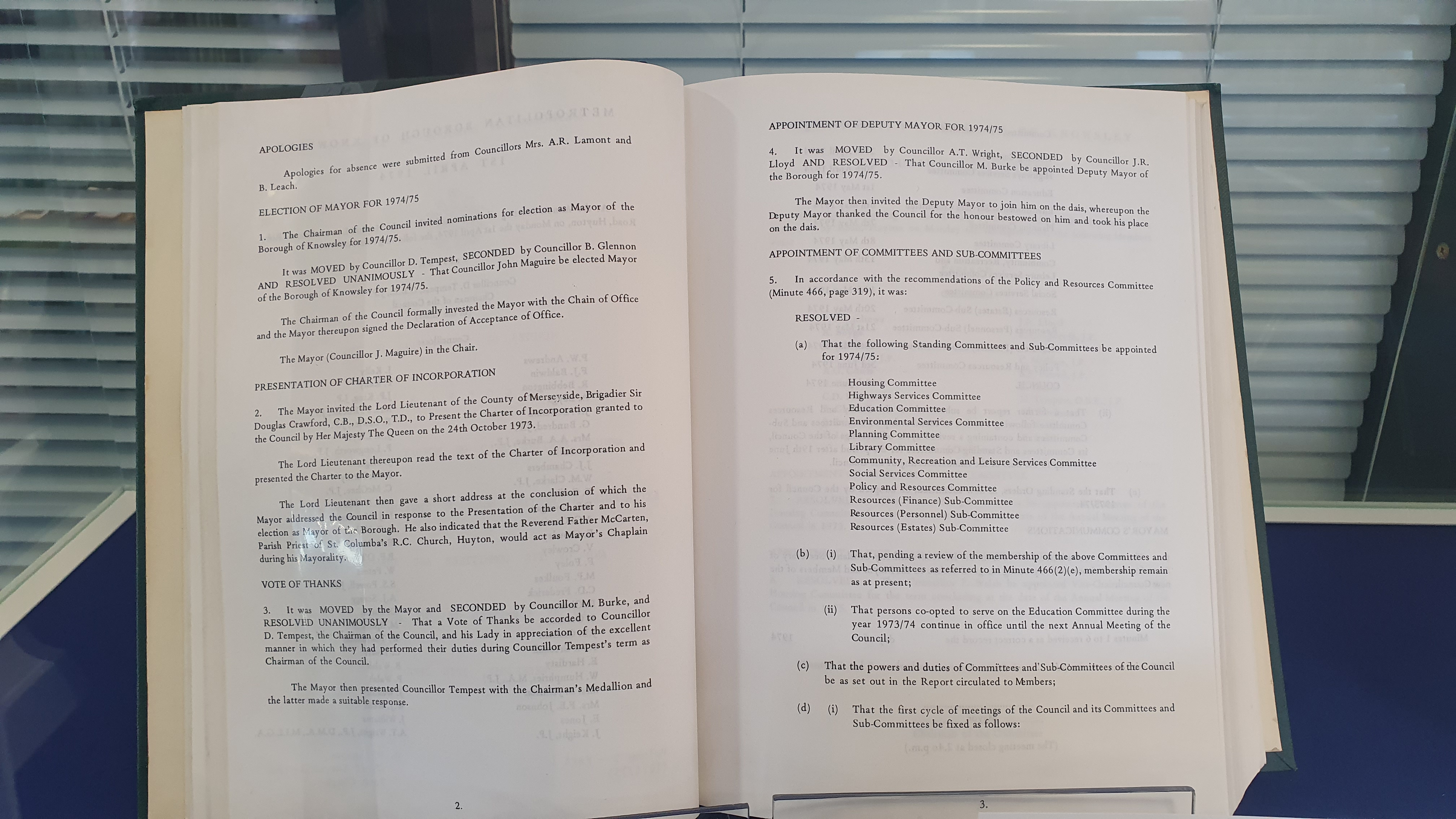
The very first volume of Knowsley Metropolitan Borough Council minutes dates from 1 April 1974 and records minutes from committee and sub-committee meetings, standing orders, terms of reference and financial regulations of the new Metropolitan Borough Council.
High on the agenda of the first meeting of the Borough Council on 1 April was the election of Mayor for the 1974-1975 cycle.
KMBC Minute book showing the minutes of the first meeting of the new Borough Council
Cllr and Mrs J Maguire, featured on a decorative plate
Moved by Councillor Tempest and seconded by Councillor Gleeson, it was resolved that Councillor John Maguire be elected Mayor of the Borough of Knowsley for the year 1974 -1975 and was duly invested with the Chain of Office. Councillor M. Burke was elected Deputy Mayor.
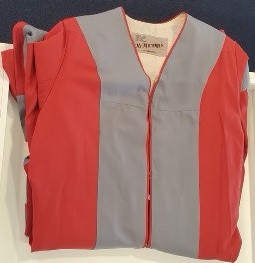
In addition to the Chain of Office, to outwardly signify their civic status, Knowsley’s Mayors traditionally wear full a robe, a hat and a fine lace stock, or jabot.
Here are examples of the robe, bicorn hat and jabot which feature in the exhibition. If the Mayor is male, the hat worn is a bicorn style, as shown here; a female would wear a tricorn, or three cornered hat:
Mayoral Robe and below, a Bicorn Hat
The Jabot, a fine lace stock
Throughout the year, there will be a rolling programme of exhibits that tell the story of the Borough of Knowsley through the lens of the Archive Collections. You’ll find us in the Archive Exhibition Space, Kirkby Library. Keep a look out for new displays, or get in touch for more information or to share your stories.
Contact Knowsley Archives Service, The ARK, 1st Floor, The Kirkby Centre, Norwich Way, Kirkby L32 8XY, call us on 0151 443 4291 or email us at infoheritage@knowsley.gov.uk.








 Knowsley Archives